The Beehive Skeptics Dowsing Challenge
Dowsing—often called "water witching" or divining—is the practice of using L-shaped metal rods, Y-shaped branches, or pendulums to locate underground water, metals, or hidden objects. Dowsers often believe that unknown forces or invisible energies physically move the tools in their hands.
To bring hands-on science to the public, Beehive Skeptics sets up interactive, simplified dowsing trials at community festivals and conventions across Utah, including:
- Salt Lake Pride Festival
- Ogden Pride Festival
- PhenomeCon
- Paracon
How Our Field Test Works
We set out 10 identical cylinder containers in a line on our table. Out of sight, we hide a single bottle of water inside one of the cylinders. Visitors to our booth are invited to use dowsing rods or pendulums to figure out which container holds the water.
- Trial 1: If a participant correctly points to the water bottle on their first attempt, we award them a free science-themed pin!
- Trial 2: To rule out pure luck, we randomize the water bottle position and container while the participant looks away and ask them to find it a second time.
- Passing: Anyone who successfully finds the water twice in a row qualifies for our formal, rigorous testing protocol.
Empirical Test Data & Results
Because there are 10 containers and only 1 holds water, random guessing gives every participant exactly a 1-in-10 chance (10%) of choosing correctly on any single attempt. Here are the live results accumulated across hundreds of festival participants:
What the Math Tells Us
Out of 520 total attempts, 51 people selected the correct cylinder on their first try. That is a 9.8% success rate—virtually identical to the expected 10% mathematical probability of random guessing.
While standard probability dictates that roughly 1 out of 100 participants should get two correct guesses in a row by pure chance (10% × 10%), only 1 participant out of 520 trials has successfully hit back-to-back trials. This data strongly supports that dowsing performance tracks cleanly with mathematical chance rather than physical or supernatural detection.
The Science: The Ideomotor Effect & Double-Blind Testing
Why Dowsing Rods Feel Real
When dowsing rods twitch, cross, or swing, it really feels like an external force is pulling them. However, scientific experimentation proves that this movement is driven entirely by the ideomotor effect—unconscious, minute muscle movements made by the person holding the rods. When someone expects or hopes the rods to move, their nervous system subtly twitches their hands and wrists without their conscious awareness.
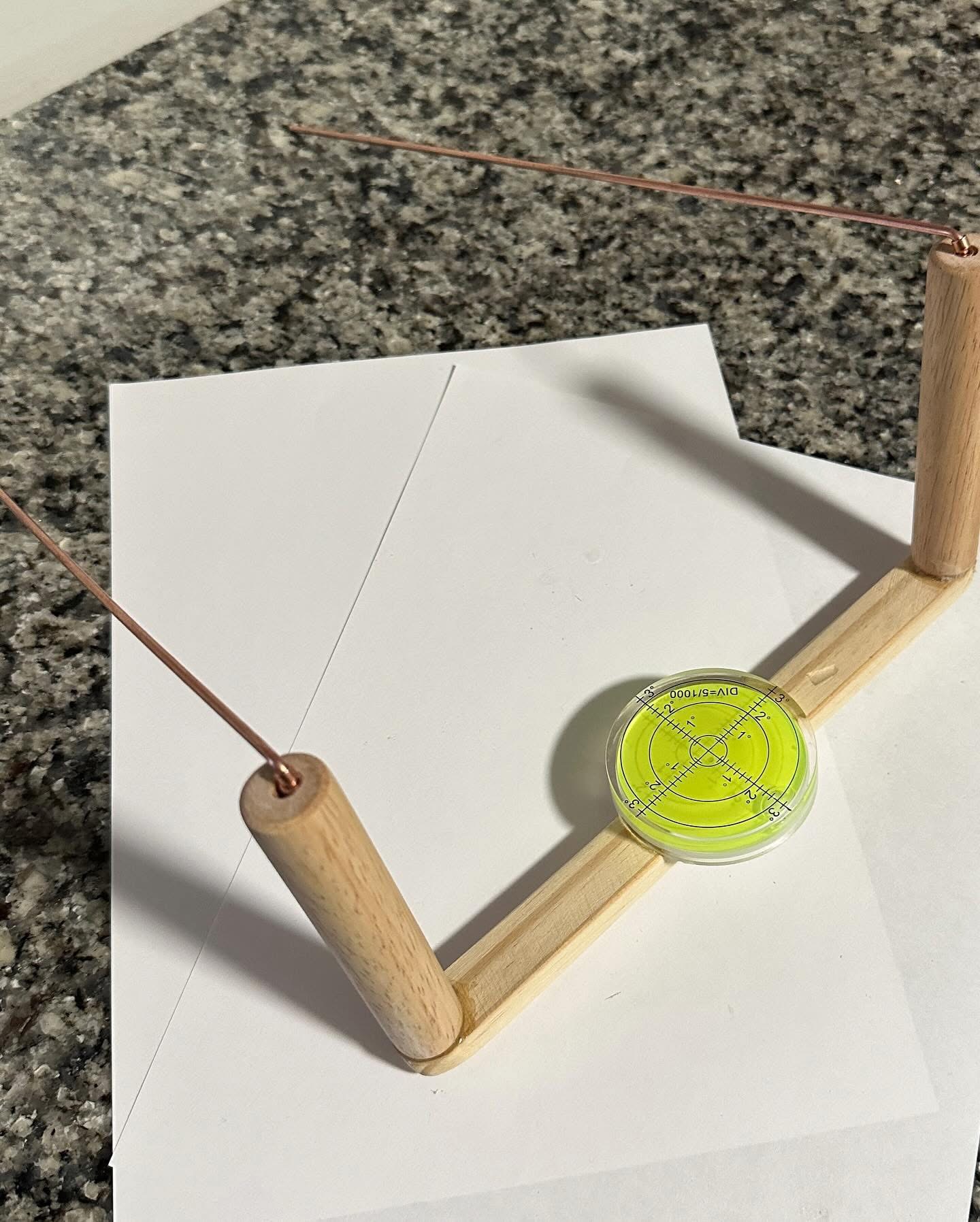
Proving the Ideomotor Effect: Locked Dowsing Rods
While our standard dowsing tests measure accuracy and intuition, we also built a modified testing rig to answer a fundamental question: Is there an external energy field or force directly pulling on the metal rods?
In this rig, two L-shaped copper rods are mounted into handles permanently locked in place on a rigid wooden crossbar equipped with a central bullseye level. Because the handles are fixed relative to each other, a user holding the frame cannot tilt or rotate their wrists independently to force the rods to cross. We usually have this rig on display at all of our events, and invite anyone to try and make them cross.
When professional dowsers try to use this rig, the rods do not cross. They can still move and swing in tangent with each other as the entire bar tilts, but without independent wrist control, they never cross. This physical proof confirms that dowsing rods do not move due to external forces, but rather from subtle, independent wrist movements caused by the ideomotor effect.
Our Formal Testing Protocol (50-Bucket Test)
For dowsers, water diviners, or paranormal researchers who believe they can reliably overcome chance, we offer a larger, formal double-blind experiment:
- Setup: Up to 50 identical buckets positioned outdoors or across a designated grid.
- Target: A larger tub of water randomly concealed under a single bucket by an isolated test administrator.
- Controls: Neither the dowser nor anyone present in the testing area knows which bucket conceals the target until all sweeps are complete and logged.
- Repeatability: A success rate of two out of three trials is required to pass. The probability of achieving this by random chance alone is approximately 0.1184% (odds of 1 in 845).
Think You Have the Gift?
If you can successfully demonstrate dowsing ability under controlled double-blind conditions, Beehive Skeptics will sponsor you for the official $500,000 CFIIG Paranormal Challenge—including covering your round-trip airfare and hotel stay in California! Contact us today to arrange a formal test.
Test Photo Documentation
Below are photos of our live tally whiteboards and tracking sheets used during our booth experiments:
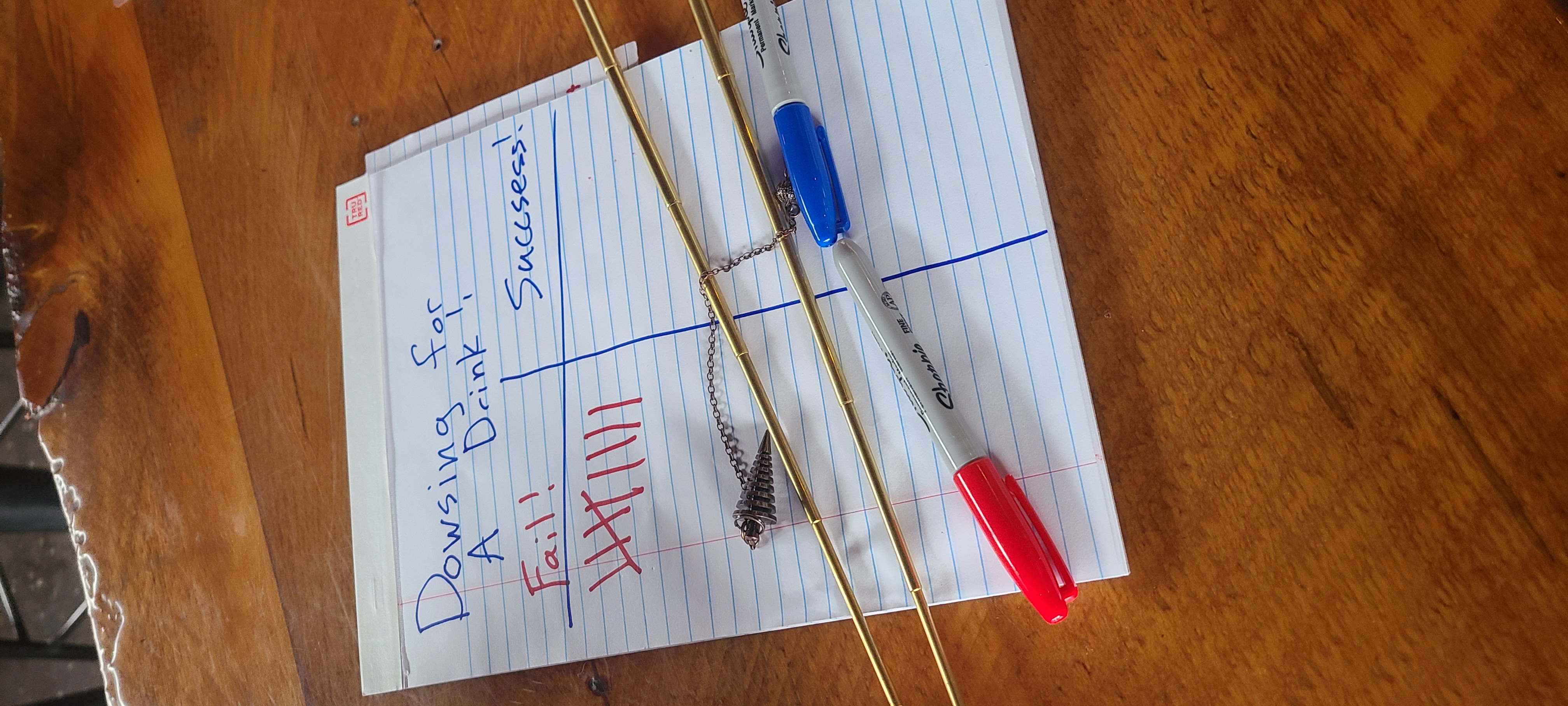
"Dowsing for A Drink" at a Skeptics in the Pub event
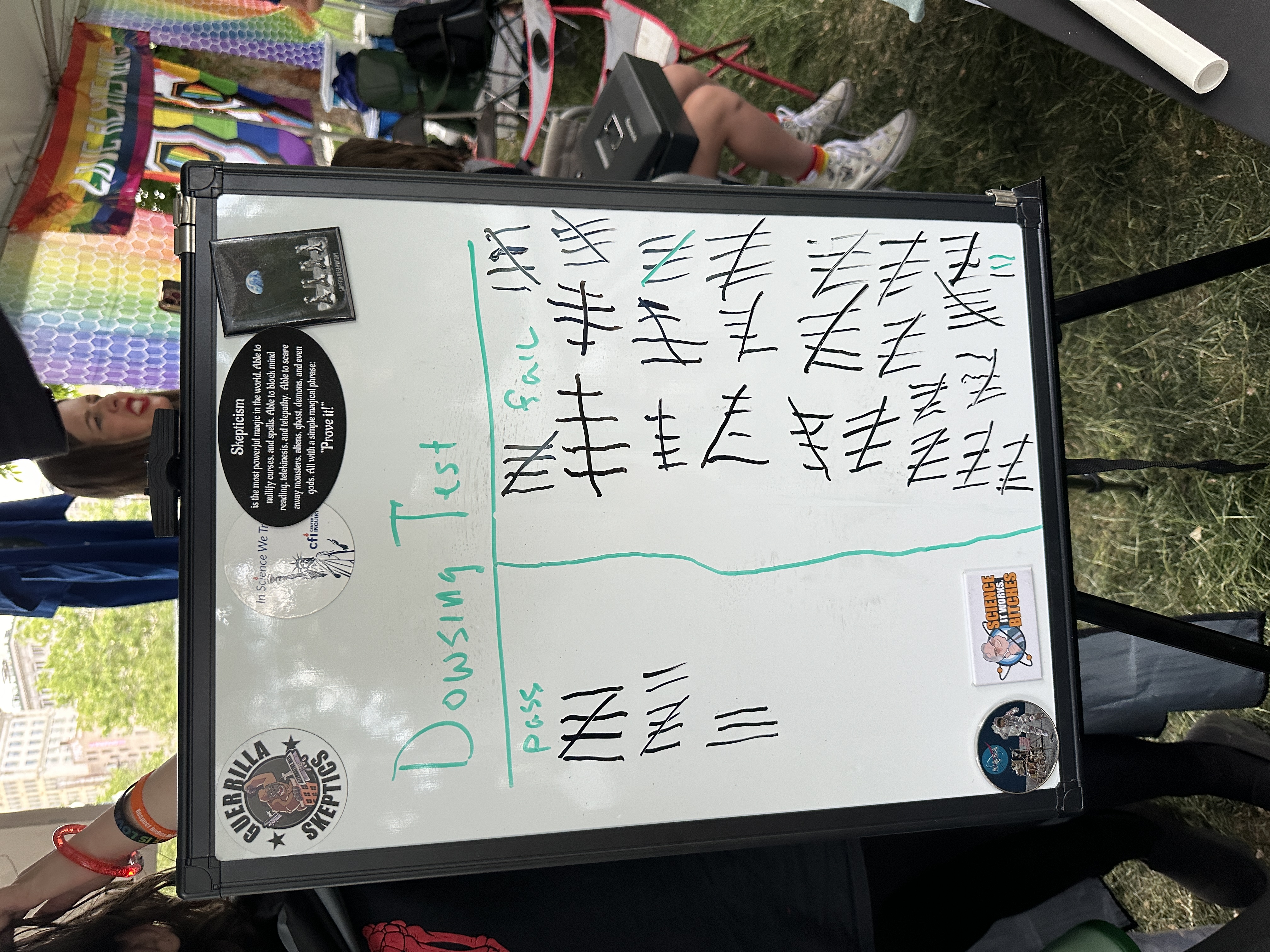
Salt Lake Pride Festival Day 1 final tally
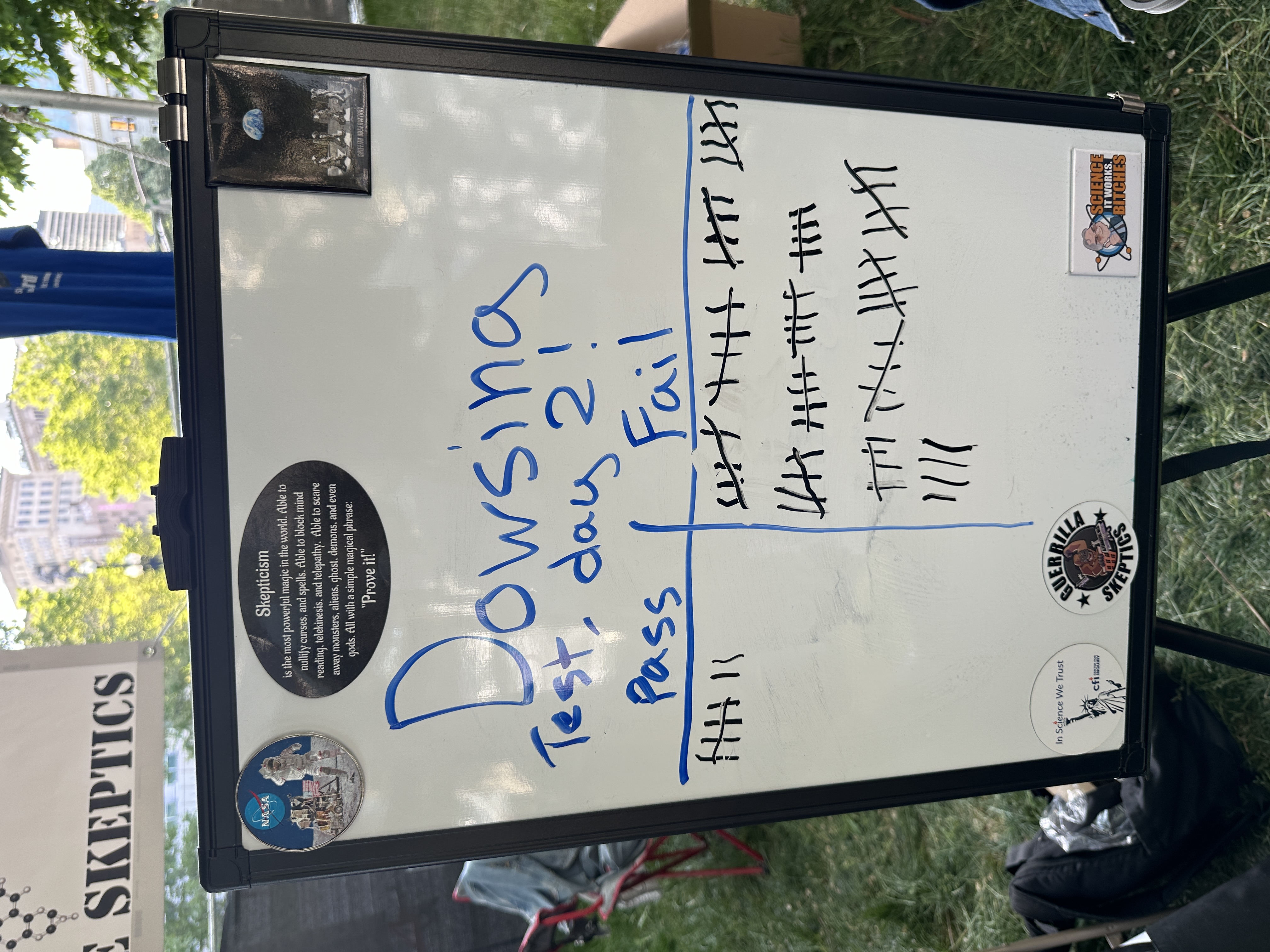
Salt Lake Pride Festival Day 2 final tally
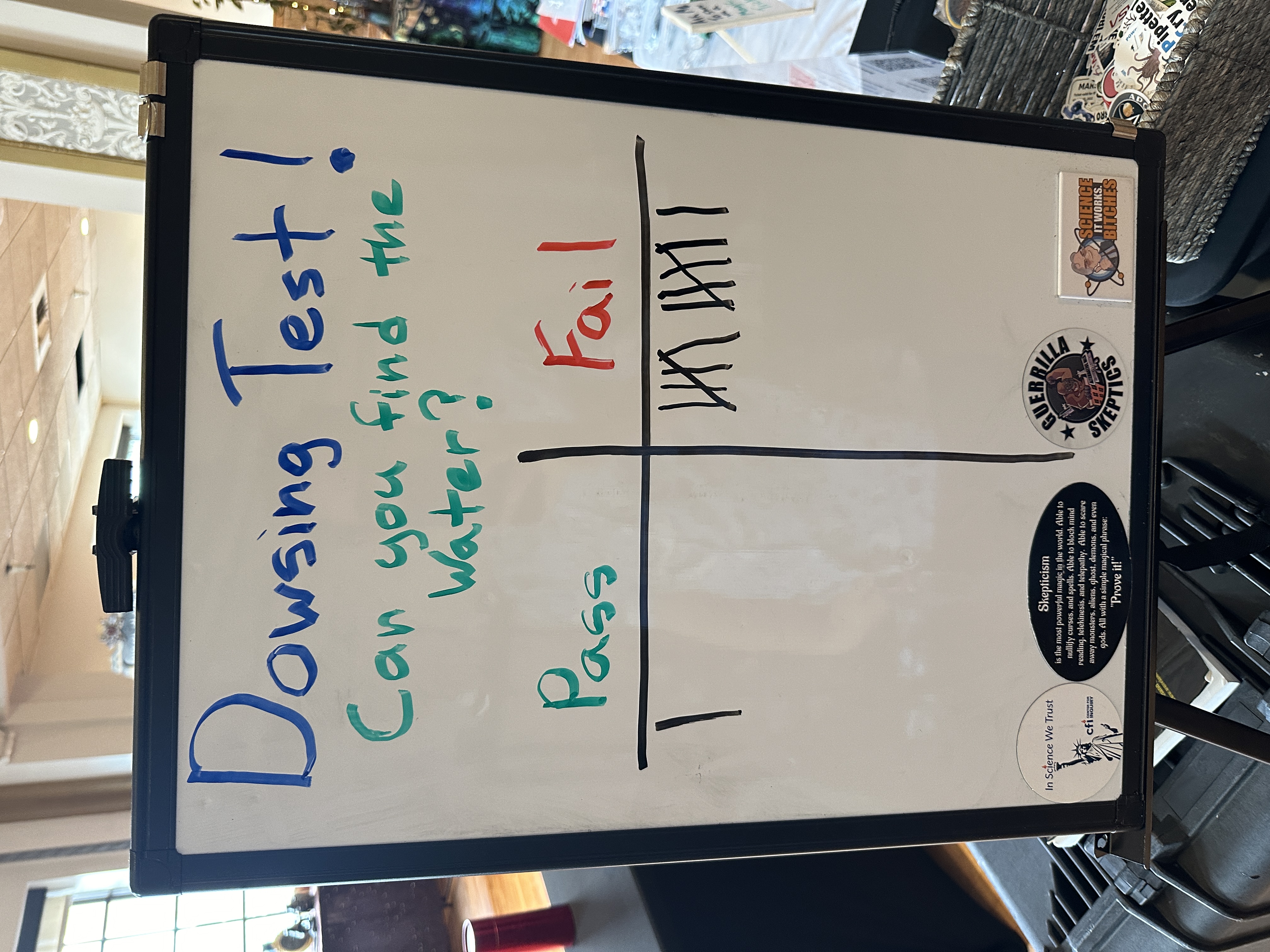
Ogden Pagan Market Tally
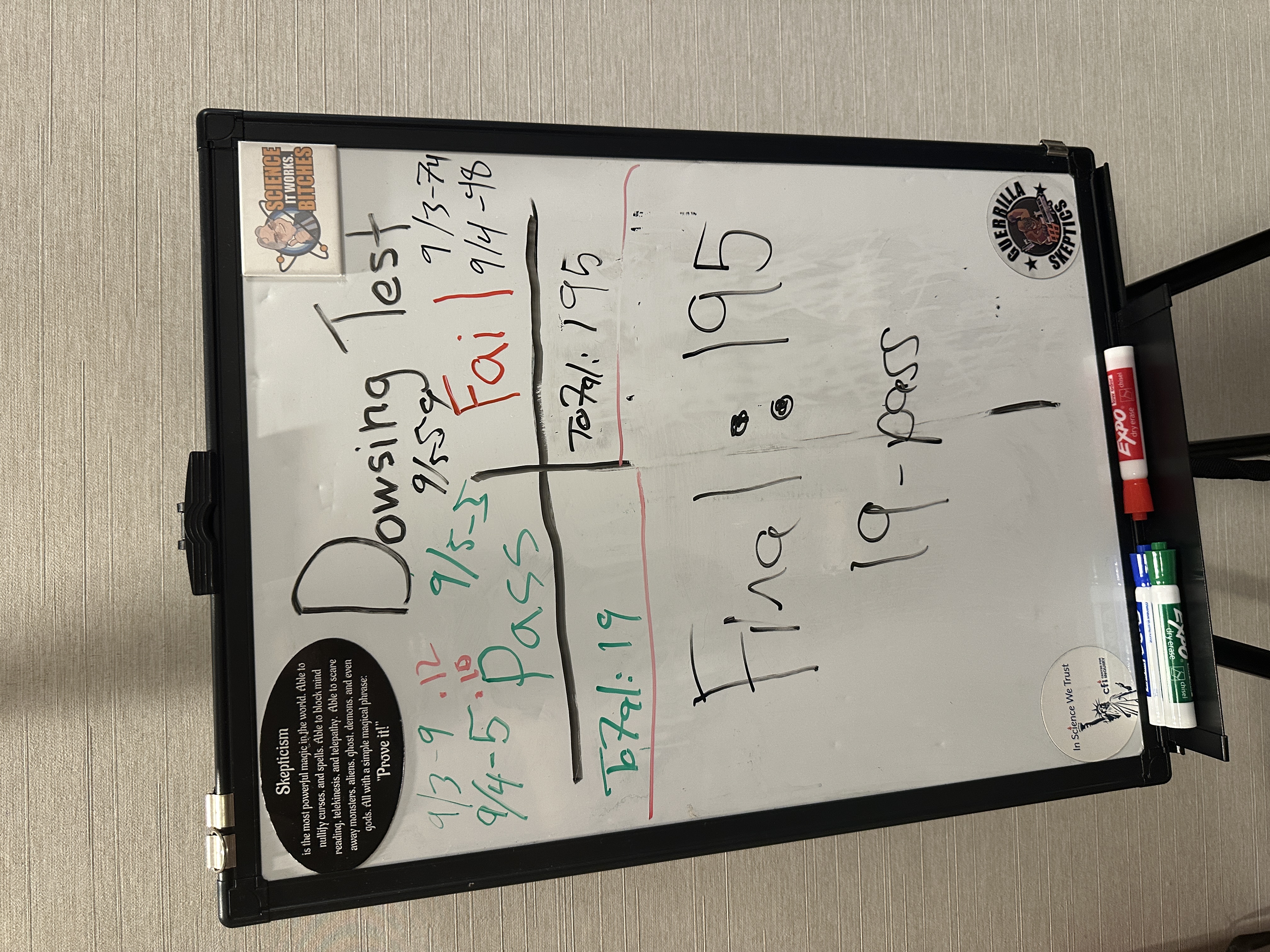
PhenomeCon final tally
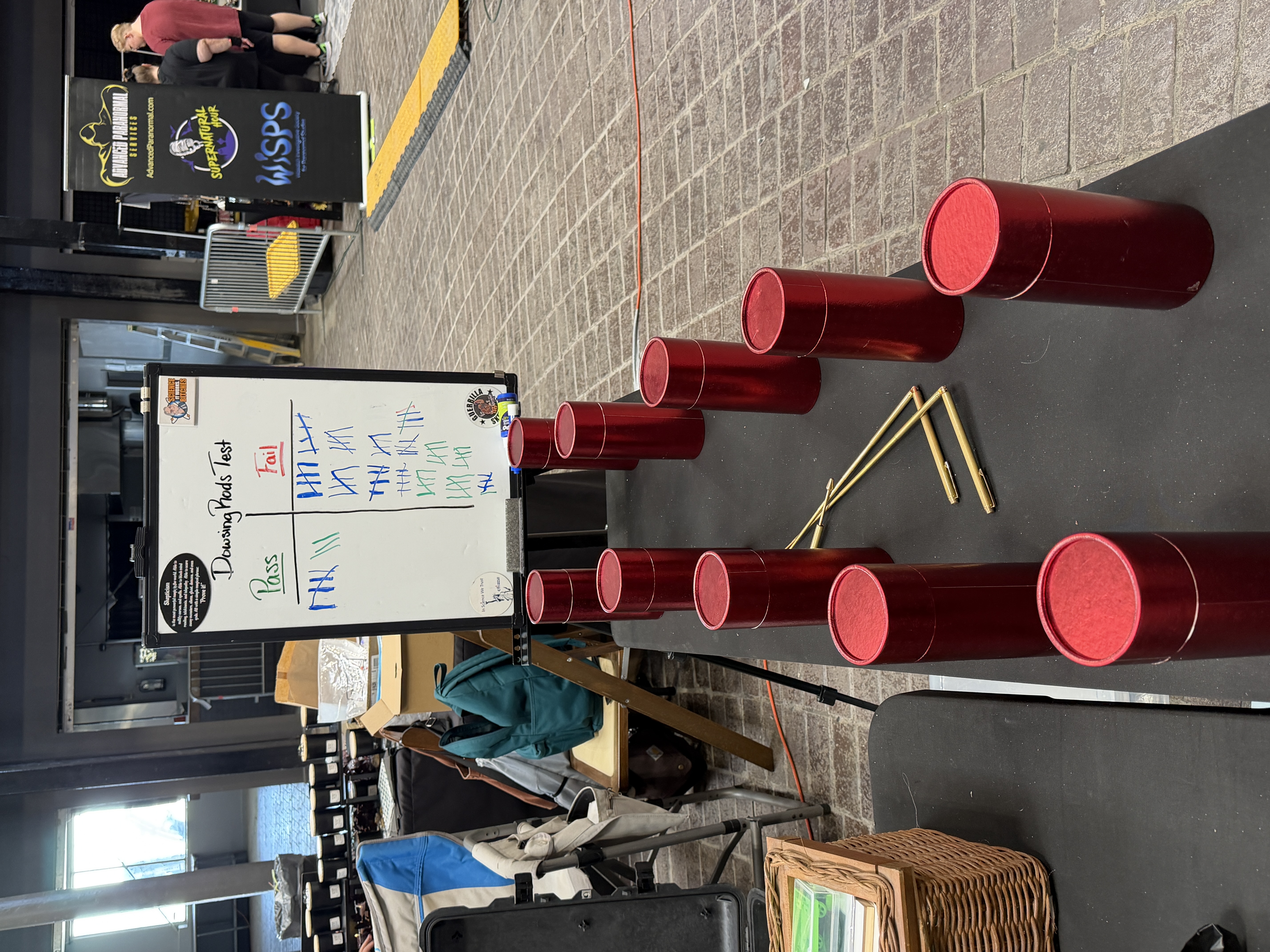
Salt City ParaCon final tally